Tag: AI
-
AI, chatbots and a new way to search
[Corrected information for Gemini in comparative section of post.]
A practical session following some demonstrations to encourage you to try out using Chatbot apps as an alternative to using a search engine. Of course most of the browsers and search engines now have the ability to “chat” added to them, ie Ecosia Chat and DuckDuckGo – which has the additional plus of you being able to choose which chatbot to use …

Claude tells me (as of October 2024) that the Edge, Opera, Chrome, Brave, Firefox and Arc browsers have this functionality, and Bing, Google (through Gemini), DuckDuckGo and Perplexity search tools have this functionality.
You can generate images too – but this is not the subject of today’s session. Look at Jonathan’s AI-generated avatar …

… or Phil’s set of images generated by Le Chat, from this script …

Screenshot 
Screenshot 


But we will look at how an image taken with your phone, or tablet, can be attached to a chatbot and get a summary of what it’s saying …

This (when sent to ChatGPT) with the one word message – “Summarise”, returned this …
- Online scamming is a global industry – It is vast, sophisticated, and growing rapidly, with criminal networks operating across borders.
- “Pig butchering” is a major scam method – Scammers build fake relationships with victims, emotionally manipulate them, and then convince them to invest in fraudulent schemes.
- Scamming is more dangerous than the drug trade – It operates beyond the reach of law enforcement, lacks regulation, and is highly scalable.
- Criminal compounds run large-scale scam operations – Many scams originate from compounds in Southeast Asia, where trafficked workers are forced into scamming.
- Advanced technology enables fraud – AI-generated voices, deepfake videos, and cryptocurrency help scammers operate anonymously and make their schemes more convincing.
- Scammers exploit human emotions – Victims fall prey to scams due to loneliness, fear, greed, and trust in online relationships.
- The economic impact is massive – Billions of dollars are stolen annually, affecting individuals, businesses, and economies.
- Law enforcement struggles to keep up – Scammers move money and people across jurisdictions faster than authorities can track them.
- International cooperation is needed – Countries must collaborate, working with banks, tech companies, and social media platforms to combat online fraud.
- Public awareness and education are crucial – Governments should implement stronger warnings and educational campaigns to prevent people from falling victim.
… but what is “pig butchering”, ask ChatGPT and you get this …
Pig butchering (shā zhū pán, 杀猪盘) is a sophisticated online scam that combines financial fraud with emotional manipulation. The term comes from the idea of “fattening up” a victim (the pig) before eventually “butchering” them for financial gain.
How It Works:
1. Initial Contact: Scammers approach victims through dating apps, social media, or even random text messages pretending to be a wrong number. They gradually build a friendly or romantic relationship.
2. Emotional Manipulation: Over weeks or months, scammers gain the victim’s trust, often pretending to be wealthy and successful. They encourage casual financial discussions, showing off their supposed investment profits.
3. Fake Investment Opportunity: Once trust is established, scammers introduce the victim to a “lucrative” investment, usually involving cryptocurrency or forex trading. They direct the victim to a fake but professional-looking website or app where they initially see small returns.
4. Encouraging Bigger Investments: As the victim gains confidence, they invest more money, sometimes even taking out loans or draining savings. The scammer keeps reinforcing the illusion of profits.
5. The Exit (Butchering Phase): Eventually, when the victim tries to withdraw funds, they encounter delays, extra fees, or are locked out entirely. The scammer then disappears, leaving the victim financially devastated.
6. Trafficking Connection: Many pig-butchering scams are operated from compounds in Southeast Asia, where trafficked workers are forced to run scams under threat of violence.Why It’s Effective:
• Long-term manipulation: Unlike quick scams, it relies on slowly building trust.
• Emotional exploitation: Victims often feel emotionally invested, making them less skeptical.
• Convincing fake platforms: Sophisticated websites mimic real investment sites, making the scam seem legitimate.
• Cryptocurrency anonymity: Crypto transactions make it difficult to trace stolen money.This type of fraud is one of the fastest-growing online crimes, with billions of dollars stolen worldwide each year.
That’s phenomenally powerful and time-saving!
So we’re going to look at installing some Chatbot apps, and doing some comparative enquiries, and end-up having some fun – I hope.
Le Chat helps me write this … “Provide a list of the most popular AI Chatbots, whether they’re open source and who they’re funded by?”
Here is a list of some of the most popular AI chatbots, their open-source status, and their funding sources:
- ChatGPT: Developed by OpenAI, ChatGPT is one of the most widely used AI chatbots. It is not open-source and is funded by Microsoft and other investors.
- Claude: Created by Anthropic, Claude is known for its conversational abilities and is considered one of the best overall AI chatbots. It is not open-source and has received significant funding from various investors.
- Google Gemini: Formerly known as Bard, Gemini is Google’s AI chatbot integrated with Google services. It is not open-source and is funded by Google.
- Microsoft Copilot: This AI chatbot is developed by Microsoft in collaboration with OpenAI. It is not open-source and is funded by Microsoft.
- Llama 3 by Meta: An open-source AI chatbot released by Meta AI. It is designed to be freely available for anyone to use and build upon. It is funded by Meta.
- Perplexity AI: Known for its ability to search the internet and provide relevant data, Perplexity AI is not open-source and is funded by various investors.
- Jasper AI: This AI chatbot is tailored for content creation and marketing. It is not open-source and is funded by various investors.
- Poe: Created by Quora, Poe allows users to access multiple AI models in one tool. It is not open-source and is funded by Quora.
- Rasa: A popular open-source framework for building conversational AI assistants. It is funded by various investors and is widely used in the developer community.
- DeepPavlov: An open-source conversational AI framework designed for developing production-ready chatbots. It is funded by various research grants and investments.
These AI chatbots represent a mix of open-source and proprietary solutions, each with its own strengths and funding sources.
Of these I do like Claude, Perplexity and Le Chat in particular, but Le Chat wasn’t in this list, why? I followed up my initial query with – “Why isn’t Le Chat in this list?”
Le Chat is an AI chatbot developed by Mistral AI, a French startup. It is designed to be a fast and efficient conversational assistant, capable of processing up to 1,000 words per second, making it one of the fastest AI models available. Le Chat is available as a native app for iOS and offers a range of features, including image analysis, content generation, and real-time internet searches. It is positioned as a European alternative to other AI chatbots like ChatGPT and Google Gemini.
Mistral AI has attracted significant investment from various sources, including American tech giants like Nvidia and IBM, as well as funding from the French government and other European investors. The company has also received support from France’s defense ministry and other European entities, highlighting its strategic importance in the region’s AI landscape.
Le Chat is part of Europe’s broader push for AI independence and is seen as a key player in the continent’s efforts to compete with major AI developers in the US and China. The chatbot is designed to offer strong privacy protections and aligns with European values regarding data security.
That’s why I like Le Chat – an element of independence from the US, but I suspect there will be a UK killer-chatbot in the wings!!!
I thought I’d do a comparative query across the different AI Chatbots I use – but in their web format so that I could do screenshots for this post [the responses would be the same on the phone/tablet – just easier for doing screenshots]. The query was fed to me by my daughter, and I followed the responses with some supplementaries (which I’m not including), but you’ll get the idea …
The enquiry … “In the UK, what I should plant in a western-facing partly shady coastal front garden with clayish soil?”
Le Chat – https://mistral.ai/products/le-chat

Screenshot Perplexity (on the web I was given Perplexity Pro – presumable for a trial period) – https://www.perplexity.ai
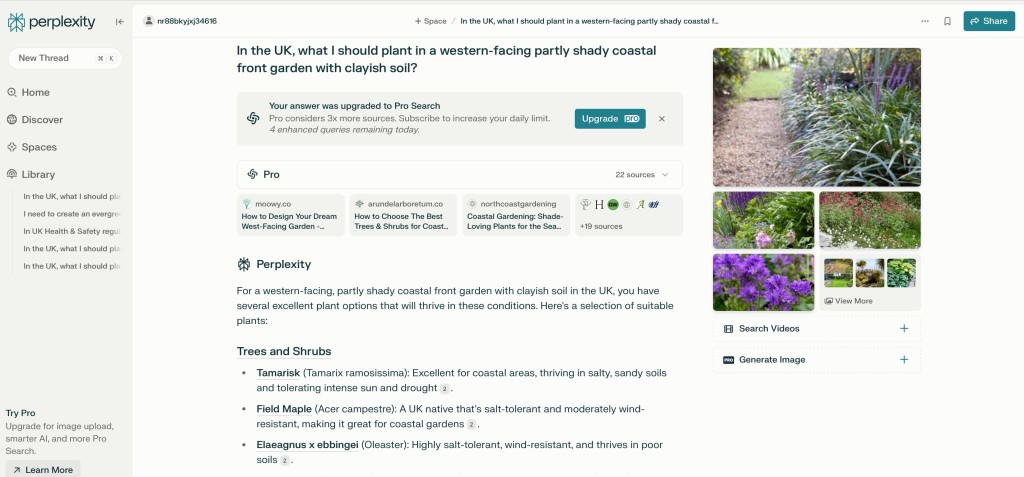
Screenshot For a full response – https://www.perplexity.ai/search/in-the-uk-what-i-should-plant-pu_I4lpmTKWVfR1U17OmrA
Claude – https://claude.ai/new
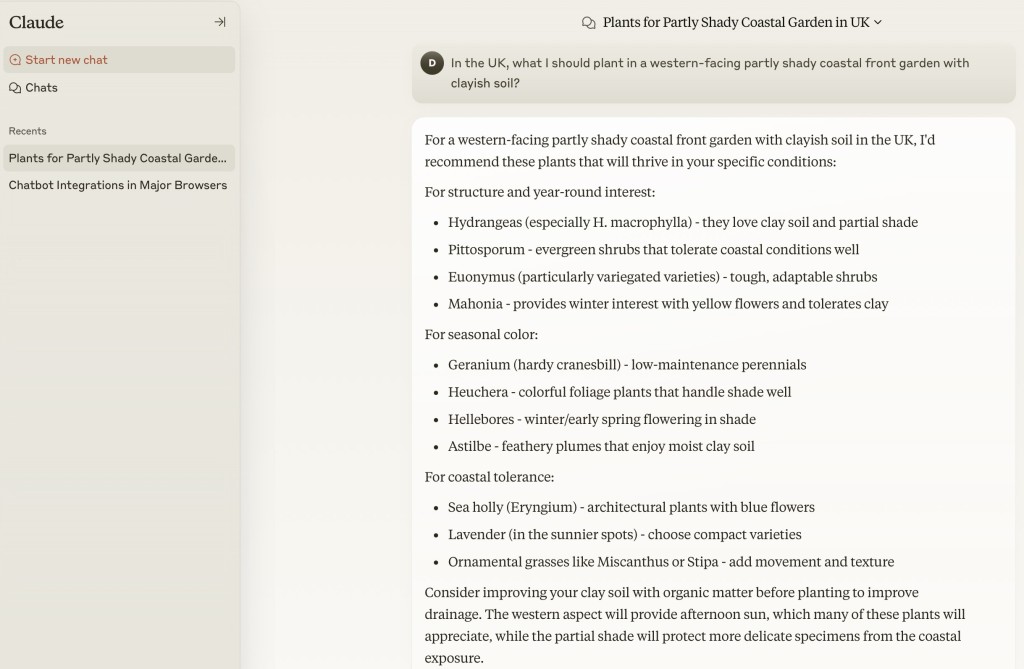
Screenshot the extreme – perhaps you have to pay to get access to Google’s own AI LLM – I’m happy to be corrected here!
Gemini (in a browser) returns this response …
https://g.co/gemini/share/ff8bfa44ae92
So to see how Gemini (in a browser looks), go to https/gemini.google.com register (or use your Google account) and type in the enquiry. From the Gemini app it looks something like this …
In the UK, what I should plant in a western-facing partly shady coastal front garden with clayish soil? 🤗

It's great you're planning your coastal garden! Coastal gardens in the UK present some unique challenges, but also opportunities. Here's a breakdown of considerations and plant suggestions, taking into account your western-facing, partly shady, clayish soil conditions:
Key Challenges:
 * Coastal Conditions:
   * Salt spray: Plants need to tolerate salty air.
   * Strong winds: Choose robust, wind-resistant plants.
   * Potential for sandy, but in your case clayish soil.
 * Western-Facing, Partly Shady:
   * Western exposure means afternoon sun, which can be intense.
   * "Partly shady" requires plants that can handle some shade but also appreciate some sun.
 * Clayish Soil:
   * Clay soil can be waterlogged in winter and dry and cracked in summer.
   * It's essential to select plants that tolerate these conditions or amend the soil.
Plant Recommendations:
Here's a selection of plants that generally thrive in these conditions:
 * Shrubs:
   * Escallonia: Very tolerant of coastal conditions and wind.
   * Photinia: Provides vibrant foliage and tolerates clay soil.
   * Hebe: Many varieties are well-suited to coastal gardens.
   * Lonicera nitida (shrubby honeysuckle): Good for hedging, tolerant of various conditions.
 * Perennials:
   * Hostas: Thrive in partial shade and tolerate clay.
   * Ferns: Many ferns enjoy shady, moist conditions (clay can hold moisture).
   * Pulmonaria (lungwort): Tolerates shade and clay soil.
   * Geraniums (hardy): Many varieties are adaptable to various conditions.
   * Sea thrift (Armeria maritima): Excellent for coastal areas.
 * Grasses:
   * Carex varieties: Many sedges tolerate clay soil and partial shade.
   * Festuca glauca (blue fescue): Can add textural interest.
Tips for Clay Soil:
 * Improve drainage: Incorporate organic matter like compost or well-rotted manure to improve soil structure.
 * Mulching: Apply a mulch to help retain moisture in summer and protect roots in winter.
 * Raised beds: Consider raised beds if drainage is a significant issue.
Where to Get More Information:
 * Royal Horticultural Society (RHS): The RHS website (rhs.org.uk) is an excellent resource for plant information and gardening advice.
 * Local Garden Centres: Local garden centres can provide tailored advice for your specific area.
When choosing plants, always check their specific requirements and consider your garden's microclimate.
Copilot – https://copilot.microsoft.com/chats/tBUeqP4WXhs3BKq8a6zy5. It has to be said the app version is quite different in appearance (so I include it below as well.
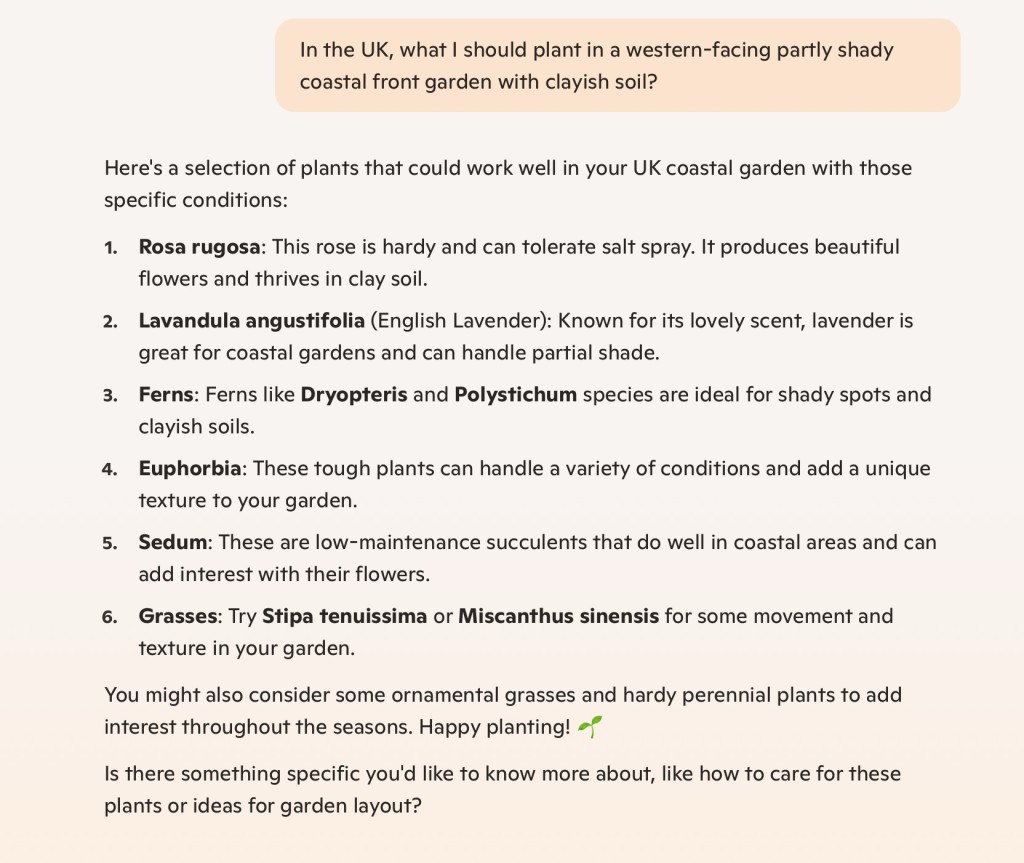
Screenshot In the UK, what I should plant in a western-facing partly shady coastal front garden with clayish soil? 🤗
Ah, a coastal garden in Wales with clayish soil—sounds like a wonderful challenge! For a western-facing garden with partial shade and a seaside breeze, you'll want plants that can handle salt spray, thrive in heavy soil, and enjoy a mix of sun and shade.
Here are some suggestions:
### Perennials and Shrubs:
1. **Eryngium (Sea Holly)** - Perfect for coastal gardens with its striking, spiky flowers and tolerance for salty air.
2. **Hydrangea macrophylla** - Thrives in clay soil and gives fabulous blooms, especially in partial shade.
3. **Hebe** - Compact, hardy, and salt-tolerant, making it ideal for coastal fronts.
4. **Skimmia japonica** - Great for partial shade, and its colorful berries add winter interest.
5. **Rosa rugosa (Beach Rose)** - Tolerates tough coastal conditions and produces lovely fragrant flowers.
### Grasses:
1. **Carex (Sedges)** - Many varieties thrive in clay soil and are low-maintenance.
2. **Festuca glauca (Blue Fescue)** - Adds texture and color, and it’s very hardy.
3. **Miscanthus sinensis** - Works well in heavier soils and creates a striking backdrop.
### Flowering Plants:
1. **Alchemilla mollis (Lady's Mantle)** - Thrives in partial shade and tolerates clay, with charming frothy flowers.
2. **Astrantia** - Adds a touch of elegance with its intricate blooms and loves partial shade.
3. **Primula vulgaris (Primrose)** - Ideal for dappled shade, and they bring an early splash of color.
### Ground Covers:
1. **Ajuga reptans (Bugleweed)** - Tolerates clay and partial shade while offering glossy foliage and purple flowers.
2. **Vinca minor (Lesser Periwinkle)** - A hardy ground cover that thrives in shady spots.
It’s also worth working organic matter like well-rotted compost into the clay soil to improve drainage and structure over time. Coastal gardens can be unique, so experimenting with a mix of hardy and native plants might lead to delightful surprises. 😊
What do you think about these options? Let me know if you'd like specific care tips or alternatives!I hope that’s of interest; I encourage you to do your own comparative enquiries, bearing in mind that they don’t all have access to up-to-date information.
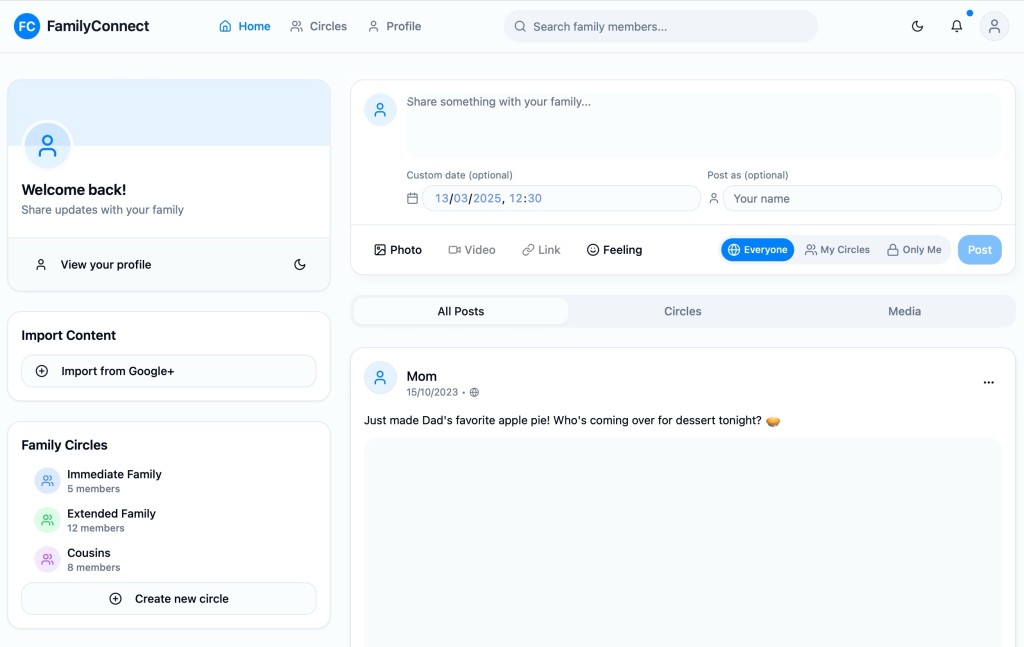
The world is changing rapidly, and my son has already demonstrated that he can build the code for the front-end of a website using a chatbot which he incorporated into his DuckDuckGo browser …
Screenshot … with the following instructions …
“I asked my new AI app writing tool to build me a private social networking tool inspired by Google+ features.
Just done the front end design, but I can add a database and I can get it to setup federation with Google login.
It’s mobile responsive as well.”
… now that’s truly amazing, but I digress.
Creating a sitcom
First prompt.
Can you come up with some sitcom names that would cover two elderly people, one who loves technology and loves setting up systems, and the other who has no idea?
then i got names … i responded -> I like wired and retired.
Second prompt
Can you write the premise of the show. The grandad gets very frustrated cause he sets up all these amazing systems and is energised by tech but his wife (grandma) is airy fairy and likes more human pursuits and poetry and gardening and is shocking at planning and execution. Both are lovely.
This was the response.
Show Title: Wired and Retired
Premise:
In the quiet suburbs, a lively retired couple navigates the collision of their wildly different passions. Frank, a tech-obsessed granddad, thrives on systems, automation, and the latest gadgets. His garage is a command center, his home a hub of interconnected brilliance—at least in his mind. Meanwhile, Betty, his whimsical wife, prefers the analog world. She spends her days writing poetry, tending to her unruly garden, and losing herself in daydreams.Their love is undeniable, but their worlds often clash in hilarious ways. Frank’s perfectly calibrated smart irrigation system gets overrun by Betty’s impulsive planting sprees. His meticulous meal-planning app gets sidelined when Betty decides dinner should be a spontaneous pic… Read more
then he just kept asking questions
until he got to …
Updated Premise:
Retired life for Frank and Betty is far from quiet. Frank, a tech-obsessed granddad, keeps busy in his upstairs office, perfecting his gadgets, cheering for West Ham, and sneaking out for his favorite snack, ‘Nice and Spicy’ Nik Naks. Betty, his free-spirited wife, thrives on poetry, gardening, and unplanned adventures that constantly disrupt Frank’s meticulously planned systems.Their quirky family dynamic adds another layer of hilarity. Their 40-something son, who lives nearby, frequently steps in as mediator and problem solver, though his visible hair loss suggests he’s barely holding it together. Their older son, who lives in Australia, adds to the chaos during his visits, gleefully stirring up trouble and playing both parents off each other.
Balancing out the chaos is their serious older daughter, a psychologist, who watches the family dynamics with professional concern. She often finds herself frustrated with her brothers’ antics and their impact on her parents, though her attempts to intervene usually go unnoticed.
Adding warmth to the mix is their youngest daughter, who lives close by with her young family. Betty adores spending time with her grandchildren, but her tendency to lose track of time often leaves Frank exasperated when she abandons his carefully laid plans for yet another spontaneous outing.
Through all the love, laughter, and occasional family drama, Frank and Betty prove that life is always better with a little humor—and a lot of heart.
Supporting Characters:
• Millie: The tech-savvy granddaughter who enjoys Frank’s high-tech world but often teams up with Betty during family adventures.
• George: Frank’s West Ham-loving best mate and snack-run partner, who adds to the laughs.
• Dorothy: Betty’s poetic and gardening partner, who fuels her creative chaos.
• Alan: The middle son, a local, stressed-out mediator whose receding hairline marks his thankless efforts to keep the peace.
• David: The mischievous older son from Australia, who stirs up trouble whenever he visits.
• Clara: The serious older daughter, a psychologist, who’s always concerned about the family’s dynamics, especially her brothers’ antics.
• Lucy: The youngest daughter, whose young family brings joy and chaos into Betty’s life, often making her forget time (and Frank’s plans).Tone:
A heartwarming sitcom full of humor and relatable family moments, Wired and Retired celebrates the beauty of intergenerational dynamics, proving that even in retirement, life is a delightful blend of love, laughter, and just enough chaos to keep things interesting.… and then we got Episodes of the sitcom …
Episode Titles:
1. “Password Protected”
Frank’s new smart home security system locks Betty out after she forgets the password during a gardening spree. Alan is called in to mediate, only for the system to malfunction spectacularly during a surprise visit from David.
2. “Nik Nak Sneak Attack”
Frank’s secret snack stash is discovered by Betty, who replaces his ‘Nice and Spivey’ Nik Naks with healthy alternatives. Desperate to retrieve his beloved snack, Frank ropes Millie into a covert snack run that goes hilariously wrong.
3. “The Poetry of Football”
Frank prepares for a big West Ham match, but Betty accidentally double-books the living room for her poetry club meeting. Clara arrives to mediate, but her psychological insights only make matters worse.
4. “Down the Rabbit Hole”
Betty gets caught up babysitting Lucy’s kids and loses track of time, leaving Frank stranded at a gadget expo. When Lucy apologizes, Frank realizes he enjoys the quiet chaos of his grandkids—until they discover his gadgets.
5. “Springsteen & Shenanigans”
David’s visit from Australia throws the household into disarray as he tries to convince Frank to join a local Springsteen tribute band while secretly encouraging Betty to paint her garden shed bright pink. Alan is left to clean up the mess.
6. “Psychologist vs. Chaos”
Clara decides to hold a family therapy session to address everyone’s dynamics. But when old grudges resurface and Frank’s gadgets interrupt the session, Clara questions if anyone can truly retire from family drama.and a 30-Minute Episode Outline:
Episode: “Password Protected”
- Cold Open (2-3 minutes)
Betty struggles with Frank’s new voice-activated front door lock after forgetting the password. She tries random phrases (“Bruce Springsteen rules!”) but is locked out. Frank smugly explains the system’s brilliance—until it locks him out too. - Setup (5-6 minutes)
Frank works on fixing the system while Betty heads to the garden, only to accidentally trigger the motion sensors. Chaos ensues as Frank’s phone floods with alerts. Alan shows up after receiving a frantic call from Betty. - Rising Action (6-8 minutes)
Alan tries to mediate, but the system glitches and locks everyone—including Millie, who came to help—inside the house. Betty starts reciting poetry to keep calm, which Frank finds infuriating. Meanwhile, David calls from Australia, adding comic commentary. - Climax (7-8 minutes)
Alan manages to bypass the system just as Betty’s gardening friends arrive for tea, unwittingly triggering the alarms again. Frank declares the system a failure and blames Betty, who points out she only wanted a simple lock and key. - Resolution (3-4 minutes)
Frank reluctantly agrees to simplify the system but secretly tinkers with it that evening. Betty catches him sneaking a Nik Nak, teasing him that even his snacks need a password.
Tag Scene (1 minute)
The system malfunctions during the night, locking the entire family in the bedroom. Betty smirks, “At least we’re safe from burglars.” Frank sighs, “Or freedom.”Each episode mixes laugh-out-loud situations with heartfelt moments, showing that even retirement is full of surprises!

Now it’s your turn!!!! This was all generated using ChatGPT, but the other AI chatbots could probably do the same.
- Online scamming is a global industry – It is vast, sophisticated, and growing rapidly, with criminal networks operating across borders.